Glacier Peak 5 Day Climb Itinerary
Day 1
We meet at our Seattle office for a 6:30 a.m. orientation and gear check. A big part of developing the necessary skills of mountaineering starts with having the proper equipment and food. Your guides will discuss each piece of gear and ensure that everything is in good condition and is a proper fit. They will evaluate conditions, discuss the weather forecast, and give a route overview. We’ll also review packing our backpacks, wilderness ethics, and Leave No Trace practices.
From the office, we will drive to the North Fork Sauk River trailhead (2,300’). Our approach begins in towering old growth forests of the North Fork Sauk River Valley. We’ll warm up and acclimate to the weight of our backpacks on the first five miles of mellow trail to the Mackinaw Shelter, where we’ll make our first camp.
North Fork Sauk River Trailhead to Mackinaw Shelter
Distance: 5 miles
Elevation Gain: 1,000 ft.
Hours: 2.5-3.5
Day 2
Climb to High Camp. After breakfast, we’ll pack up camp and continue toward Glacier Peak. Shortly after the shelter, the trail begins gaining elevation in earnest for roughly 3 miles to the junction with the Pacific Crest Trail (6,000’). Although this stretch is steep, there will be glimpses of the mighty Sloan Peak, fields of wildflowers, and whistling marmots. From the junction of the PCT, we’ll hike to White Pass, where we’ll meet up with the Foam Creek Trail which we’ll follow to the edge of the White Chuck Glacier around 6,800’ where we’ll establish our high camp.
Mackinaw Shelter to High Camp
Distance: 6 miles
Elevation Gain: 3,800 ft.
Hours: 4.5-6.5
Day 3
Training day. Today is all about learning the ropes of glacier travel. After a good night’s sleep to recover from the last two days of approach, we will begin a robust day of training. Guides will cover managing risk on the climb, including glacier travel, self-arrest, crampon technique, ice axe usage, and proper rope techniques including knots. With a break for lunch and some additional practice to follow, training will take most of the day. After an early dinner, we will head to bed in anticipation of a pre-dawn start for the summit, resting and recovering as much as possible.
Day 4
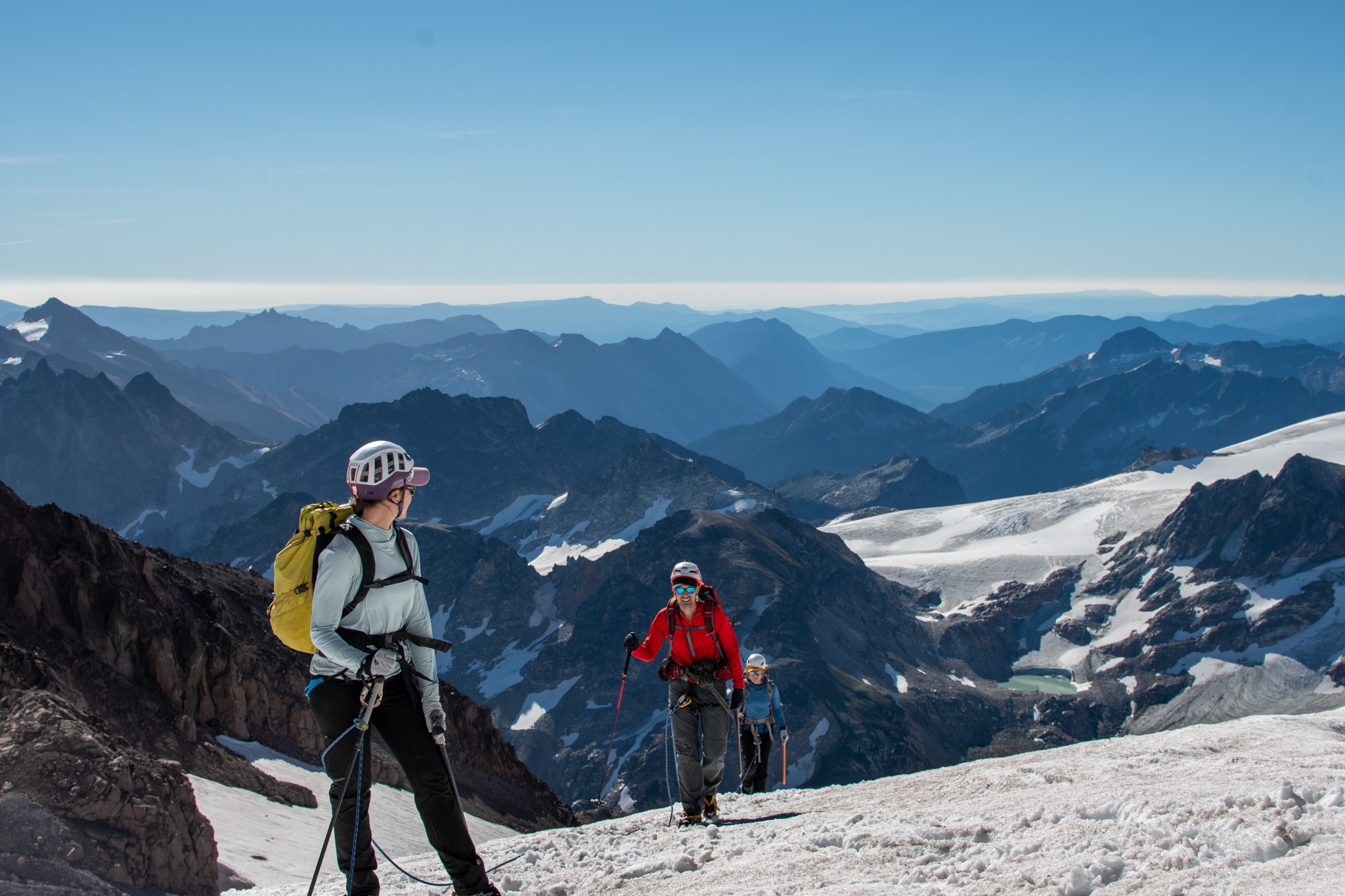
Summit day! We get a pre-dawn start (alpine start) to take advantage of the best snow conditions on our journey towards the summit. The climb is very remote with a few short steep sections as we head around Disappointment Peak and climb snow and rock slopes on our way to the summit at 10,520’. Expect sweeping panoramic views of the Glacier Peak Wilderness, Mount Baker, and Mount Rainier. After descending from the summit, we will either return to our high camp, or move our camp back towards White Pass, shortening our final day’s mileage and debriefing our summit day.
High Camp to Summit
Elevation gain: 4,200 ft.
Miles: 4.5
Hours: 6-8
Summit to White Pass
Elevation loss: 4,620 ft.
Miles: 6.5
Hours: 4-5
Day 5
Descend and return to Seattle. We’ll hike the final distance along the river and through the old growth forest, aiming to reach the trail head in the early afternoon. We’ll rest our tired legs in the van on the drive back to Seattle, stopping for a celebratory meal en route.
White Pass to North Fork Sauk River Trailhead
Distance: 8.5 miles
Elevation Loss: 3,850 ft.
Hours: 4-6
Itinerary subject to change due to conditions.
All three guides are very personable, and so different from each other! I learned different things from each, and was encouraged in vastly different ways by each.