Submission by Don Wargowsky
When you’re gearing up for a climb, few pieces of equipment matter more – or cause more confusion – than your boots. They’re the connection between you and the mountain, the difference between warm, dry feet and a miserable retreat back to camp. With so many options on the market, figuring out which boot you need can feel overwhelming. The truth is, there’s no single “best” boot – only the best boot for your climb, your conditions, and your feet.
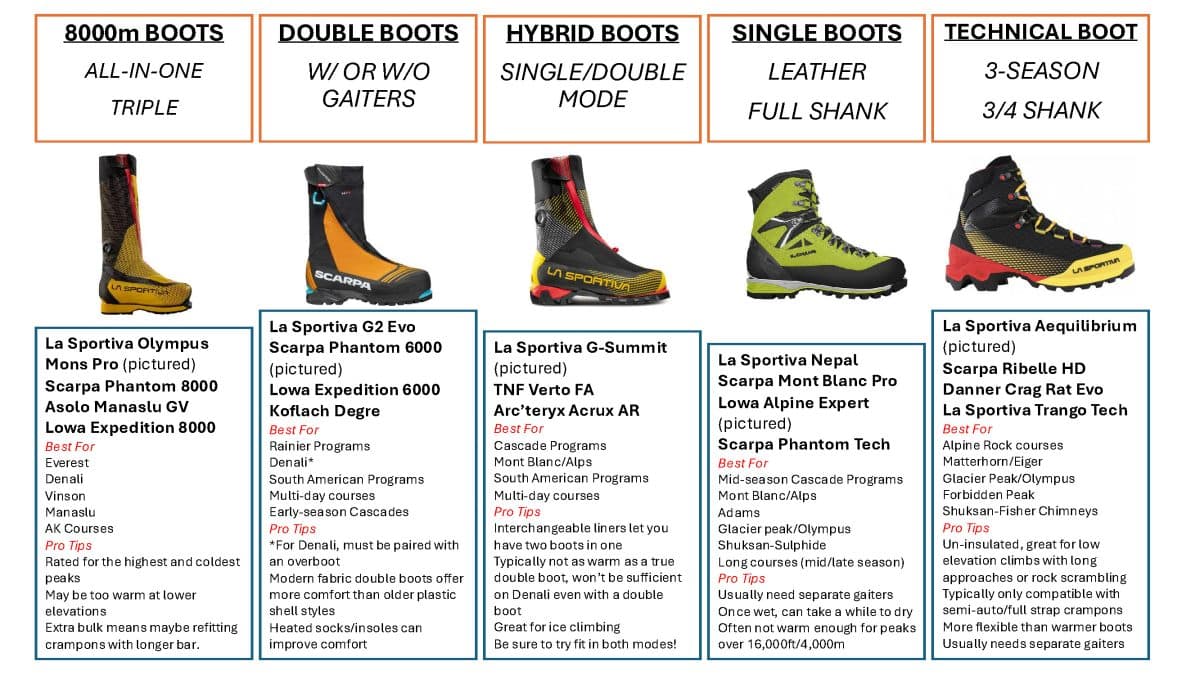
So, where do we begin? First, you need to determine what type of boot you’re looking for. Mountaineering boots are typically broken down into four categories – Technical, single, double, or 8000m boots.
Technical Boot (sometimes known as a 3/4 Shank or 3 Season Mountaineering Boot) is a step up from your classic hiking book. The ‘shank’ refers to a steel or carbon fiber strip of material in the sole of the boot that makes it completely ridged. A 3/4 shank boot is inflexible for the back 3/4 of the sole, but flexes at the instep and toes. The rest of the boots on this list are full shank (entirely rigid). 3/4 shank single boots are great for alpine climbing that involves a variety of terrain. The semi-flexible sole allows for more precise footwork on rock, snow and ice. They are more comfortable for approaches, and lighter weight in general. Technical 3/4 shank boots typically have less insulation than full shank boots, and because of their flexibility, they don’t connect as securely with crampons as full shank boots do.
Pros: lightweight, flexible, comfortable
Cons: less secure with crampons, lightly insulated, require use of a gaiter
Examples: La Sportiva Trango or Aequilibrium, Scarpa Charmoz
Single boots are the lightest and least warm full shank boot, making them a great choice for lower-elevation climbs or early/late-summer ascents of peaks like Baker or Rainier. They typically feature a leather or composite outer surface and varying amounts of insulation. They also come with a variety of crampon attachment styles ranging from standard looking hiking boots to specialized boots for ice/mountain climbing which have small shelves on the toe and heel that accommodate “automatic” crampons.
While single boots shine on climbs in fair conditions, they can be a poor choice for multi-day trips in cold or wet snow. Because they don’t have a removable liner, they can’t be dried easily, leaving you with cold, soggy feet if conditions don’t cooperate.
Pro: Lightest weight full shank boot, comfortable, solid crampon attachment
Cons: Not as warm as double boots, heavier than 3/4 shank boots
Examples: La Sportiva Nepal, Scarpa Mont Blanc Pro GTX
Double boots are the next step up in warmth – and the go-to choice for early and late season climbs on Rainer. Unlike single boots, they have a removable inner liner inside an outer shell; similar to a ski boot. This design makes them significantly warmer than singles boots, though it comes with added weight. They’re commonly used on high-elevation peaks in warmer climates, such as Aconcagua in Argentina, Orizaba in Mexico, Cotopaxi in Ecuador, and Alpamayo in Bolivia. The real advantage of doubles, especially on multi-day trips and expeditions, is that you can pull out the liner at night, tuck it into your sleeping bag, and wake up to warm, dry boots – something you can’t do with a single boot. This small detail makes a huge difference when climbing day after day in cold, wet conditions that would otherwise leave your footwear soggy. Many modern double boots include an integrated, calf-high gaiter that protects the laces and keeps snow out, further improving comfort and performance.
Pro: Very warm, easy to dry out
Cons: Heavier and more expensive than single boots
Examples: La Sportiva G2, Scarpa Phantom 6000 HD
8000m boots, also called Triple boots, take the double-boot design one step further. Like doubles, they have a removable liner inside a shell, but 8000m boots add an insulated, integrated gaiter that extends nearly to the knee. This makes them the warmest mountaineering boots in the world – purpose-built for the coldest, highest peaks. All that insulation adds weight, but manufacturers offset it with lightweight sole materials. The trade-off is durability. These softer soles wear out quickly on rock, which is why triple boots should almost always be paired with crampons, and aren’t ideal for routes with a lot of exposed rock. For example, we don’t recommend triples on Aconcagua. The terrain would chew through the soles, and at their steep price point, you’ll want them to last for when you truly need them – on 8,000m expeditions like Everest or Cho Oyu.
Pro: Extremely warm, easy to dry out
Cons: Heavy, expensive
Examples: La Sportiva Olympus Mons Pro, Scarpa Phantom 8000 HD
Choosing the Right Boot
When it comes to mountaineering boots, there’s no “best” option. It all depends on your climb. First, we determine which of the types of boots we need based on the weather, temperatures, and terrain that we expect to see on the mountain. Once we’ve established which type of boot is needed we can start the search for specific models. Which double boot is best? Whichever one fits your foot best. Everyone has different feet. The ideal boot for one person might be terribly painful for someone else.
- Technical boots: Lightest, most agile, and comfortable boots. Best for lower-elevation, technical climbs like Shuksan Fisher Chimneys, Forbidden Peak, Cascades Intermediate Course, Alpine Rock Course, Matterhorn, Eiger, Glacier Peak, Olympus, Haute Route Trek
- Single boots: Lightest and least warm full shank boot. Best for lower-elevation climbs or mid-summer objectives like Baker or Rainier. Not ideal for multi-day snow camping since they can’t be dried easily.
- Hybrid boots: Interchangeable liners allow these boots to fit both single and double boot needs, though the double setting is typically not as warm as a true double boot and may not be sufficient for all expeditions that a double boot would be used for.
- Double boots: Warm, durable, and expedition-ready thanks to the removable liner. A versatile choice for early and late season in the Cascades and for big peaks in warmer climates like Mexico, Ecuador, Peru, and Bolivia.
- 8000m boots: The ultimate in warmth, designed for the world’s coldest and highest peaks. Best reserved for 8,000-meter giants like Everest and Cho Oyu, not for objectives with lots of rock like Aconcagua.
Think of singles as your “summer in the Cascades” boot, doubles as your “all-around workhorse,” and triples as your “big guns” for the coldest, highest expeditions on earth. Choose wisely because cold toes can ruin even the best summit day.
Beyond the Basics: Overboots
On climbs like Denali, Peak Lenin, and Vinson, Alpine Ascents gives climbers the option of wearing triple boots or double boots with an additional overboot. Like any climbing system, there are pros and cons of each. If you’re aiming for 8,000-meter peaks like Manalsu, Cho Oyu, or Everest, you’ll eventually need a pair of triples. Using them on Denali can be a good way to get familiar with the system, though they may feel overly warm at lower elevations. For climbers whose feet tend to run cold, we recommend triples. They will be warmer than the double/ overboot combo.
For people who don’t plan to climb something taller than Denali or colder than Mt. Vinson, the double boot/overboot combo is a great option. By the time most climbers are ready to climb these peaks, they own a pair of double boots. By adding a neoprene overboot, climbers can stretch the comfort range of their boots by a few degrees and avoid buying a pair of triple boots. Several companies make overboots, but the best by far is 40 Below. Their overboots are the warmest, most durable, and crampon compatible overboots available. We highly recommend them. A big advantage of the overboot system is that it can be added for especially cold days, meaning that climbers feet can stay a little more comfortable when the temperatures are higher, then add overboots for summit day. Pro tip: You can also put down camp booties in overboots for some additional warmth.
The Final Word
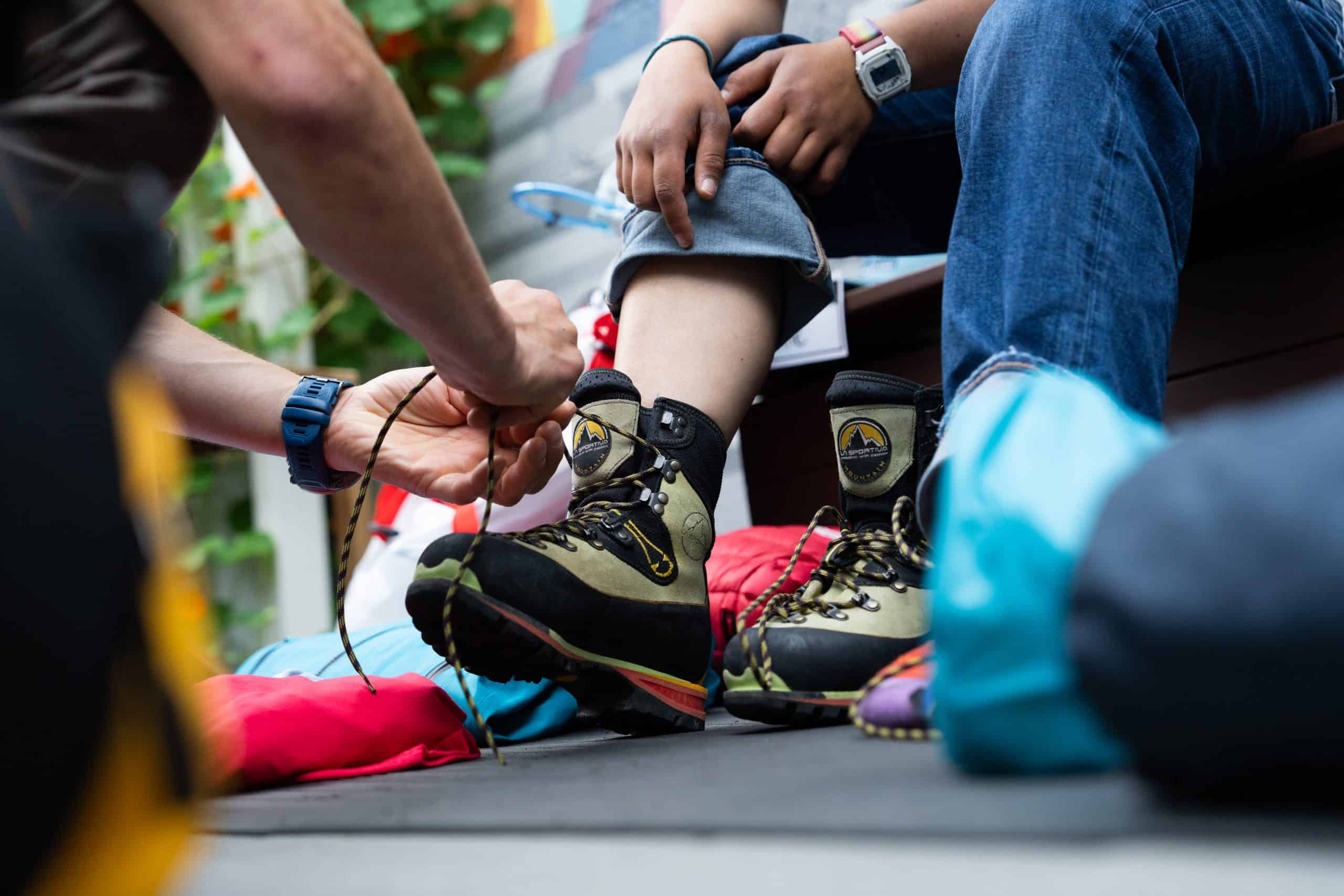
So which boot or boot system is best for you? Unfortunately, there’s nothing that you can read online that will answer that question. Start out by trying several models in a retail store. Alpine Ascents carries many of the best boots available. If possible, try renting a pair and make note of what you like/dislike about them. Some manufacturers are known to be best for certain foot types. For example, La Sportiva tends to work well for lower volume feet as opposed to Scarpa which typically fits people with a larger volume foot. When in doubt, talk to an expert. The gear staff and guides at AAI are always happy to help and make suggestions. Just remember that the “best boot” is the one that fits YOUR feet.
Here’s a video of one of our guides walking you through the various boots described in this article: