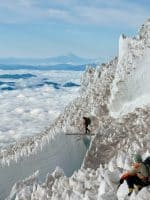
Guide Brooke Warren in prime insulated pant conditions on the summit of Mt. Rainier. Photo by Patrick Chu.
Insulated Pants can seem like a burden (will my legs really be that cold??), but they can be a critical piece of clothing in mountaineering, and can make a cold night at camp much more pleasant.
Why are they necessary?
While it may seem as though insulated pants are overkill, there are a number of reasons that may make them necessary during your climb. Many of the summits we climb in the United States and around the world can be extremely cold. Some are at such an altitude that they could be needed at any time during the year (Kilimanjaro, Aconcagua, Vinson…). Others are notorious for their cold, windy, and often snow laden conditions (Denali, Rainier, Mexico’s volcanoes).
When will I wear them?
The obvious answer to this question can be simple – when it’s cold. But it can be more nuanced than that. You may need them on summit day or before in extremely cold weather, where baselayers, hardshells, or other pants just won’t cut it. You may also need/want them in the evenings and in the mornings when you’re generally stationary, but the idea of being warm and cozy and wrapped in down feathers sounds really nice. Lastly, and potentially most importantly, you may need them in the event of an emergency. Having to stay stationary and wait for a rescue can be a chilly proposition. Just like other emergency items, insulated pants can be critical when needed.
What features are needed?
- First and foremost, you’ll want your insulated pants to have full length side zippers. This allows them to be easily taken on and off while wearing boots and/or crampons, without even having to lift a foot off the snow.
- Second, they should be sized to fit similarly to your insulated parka. Much like your parka, insulated pants are used as an outer layer (over any other pant layers), and so are generally sized up one size in order to accomodate layering underneath.
- Lastly, being the outer layer, insulated pants can be used in some rough environments – they should have reinforced knees, seat, and kick patches in order to make them durable and long lasting. Our go-to insulated pants here in the AAI Gear Department are the Rab Photon Pants.
Can I use my ski pants instead?
Generally no, ski pants will not be a good replacement for this item. Ski pants are typically hardshell pants with built in insulation, making them impossible to mix and match layering depending on the conditions. Remember, we do not want to sweat while mountaineering! Ski pants also almost never include full length zippers, a critical feature for both safety and convenience as mentioned above. Lastly, ski pants generally weigh more and are more bulky than a pair of dedicated insulated pants. This will mean that you’re carrying more weight, have less room in your pack, and won’t be able to layer efficiently.
Whether high in the Himalaya, or a June climb on Mt. Rainier, insulated pants are an excellent item to have in your kit. You’ll be glad you did!
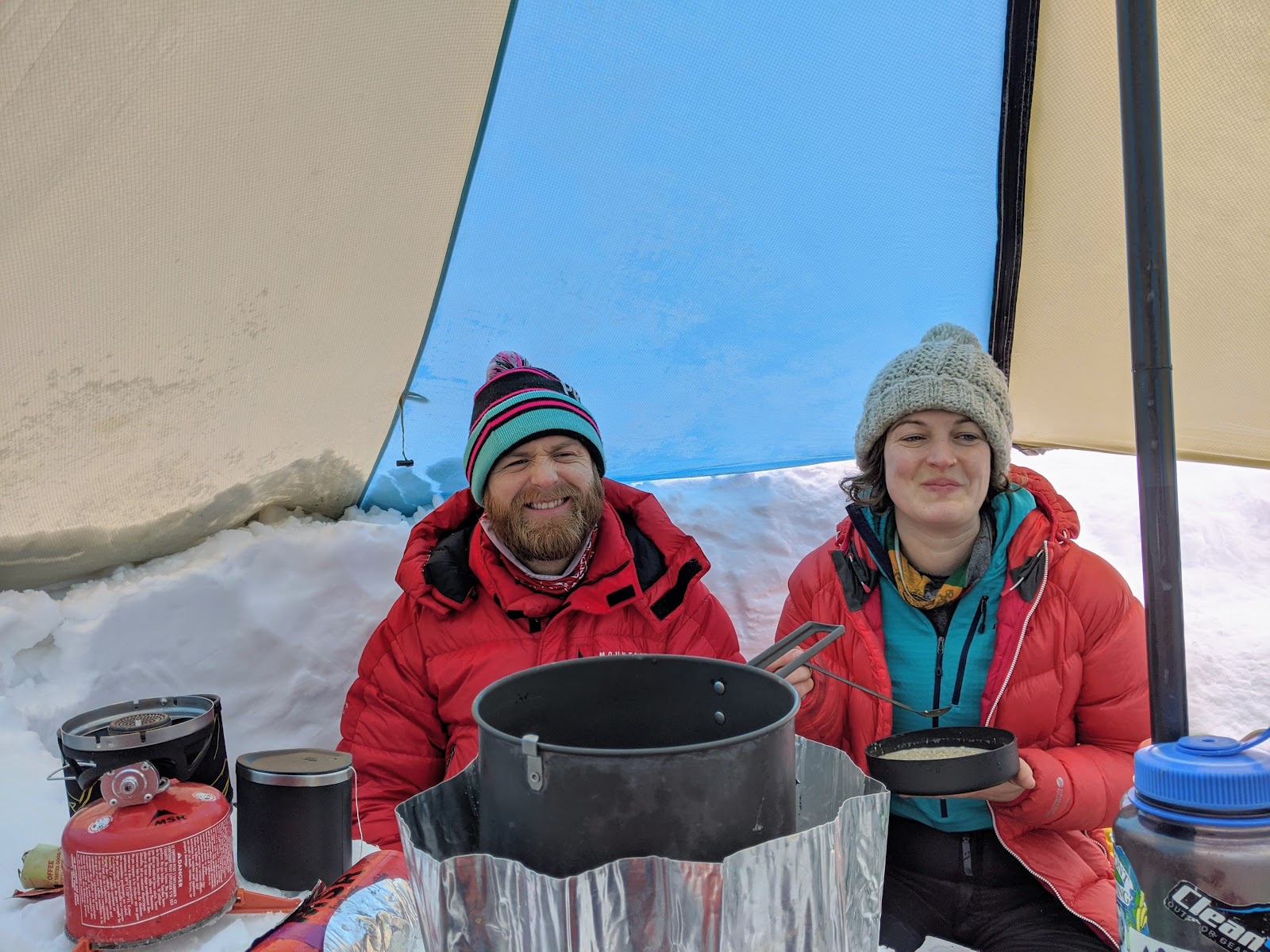
Head to toe in comfy insulation. Photo by Rebecca Hunter.