“Desert Rats Fly South for the Winter”
El Chalten Patagonia, 12/30/24-1/11/25
Trip Report by Alpine Ascents Guide Lauren Hebert, expedition made possible by the Alpine Ascents JRG Exploration Grant.
Climbers: Lauren Hebert, Katie Grauel
Objectives Climbed:
- East Face of Mojon Rojo, 4th, mod. snow, Grade II
- Giordani Ridge on Aguja Guillamet, 5.7, 1,000 ft.
- East Face of Aguja de l’S, 5.9, easy snow, Grade III (climbed 5 of the 6 pitches)
In the weeks leading up to our trip to Patagonia I had been (somewhat obsessively I’ll admit), monitoring the weather models for the mountains around El Chalten. “Patagonia”, a place name that for many climbers conjures images of adventure, unbelievable craggy skylines, and gnarly weather, and a testing place for climbers throughout the years. My thoughts spun with “what ifs”. What if we go all the way down there and the weather is never good enough to climb anything? What if we get there and are too intimidated to even get on the climbs? (You get the picture). Ultimately, our bags were meticulously packed, travel arrangements had been made, and we were headed south.
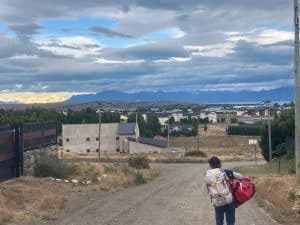
I first visited this area of the world several years ago when I took a trip to the climbing area called “Frey” outside Bariloche, Argentina. I was smitten with the landscape, and had always in the back of my mind been scheming a trip further south in the region. The stars seemed to align when my friend and climbing partner Katie Grauel also expressed interest in a Patagonia adventure. Katie and I first met in 2014 when we were training as new instructors at the Colorado Outward Bound School in Leadville, CO. We now both base ourselves out of Moab, UT, and climb frequently together on the sandstones cracks we both enjoy so much.After an approximately 40-hour long travel sequence that involved five airports, cars, and multiple bus rides, we arrived in El Chalten by bus at 11:00am. In the days we spent travelling down, a weather window had materialized. It looked like the weather was going to be good the day we got there, and the next day, before some high winds came in. Not wanting to waste a weather window, we had decided to get to town and immediately head into the mountains. By 2:00pm that same day our bags were packed, groceries and fuel had been obtained, and we were hitting the trail.


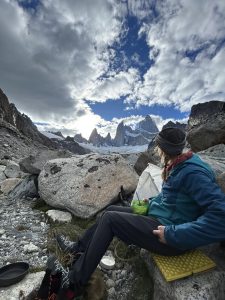

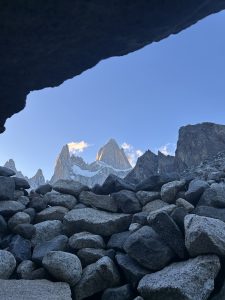
The next morning we awoke in the dark and got started about a half hour before first light. Right off the bat we had to cross a river that is the outflow for Laguna Sucia. What we had assumed would be a rock hop instead proved, in the dark, to be a wade. On our return with the light of day, we would find a better fording point, but in the dark we took off our shoes, rolled up our pants, and crossed at a point that had thigh deep water at its deepest. Well, we came here looking for adventure, and it was already feeling that way! After crossing the water, we contoured the lake and began a steep, loose ascent up a relatively well trodden climber’s path toward the “Swiss Bivy”. Alpenglow lit up the peaks of the Fitz Roy massif in a brilliant orange, just as we crossed another stream that was somewhat steep and formed a waterfall of sorts, cascading down the hill towards the lake.


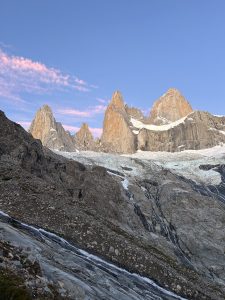
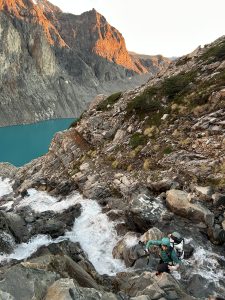
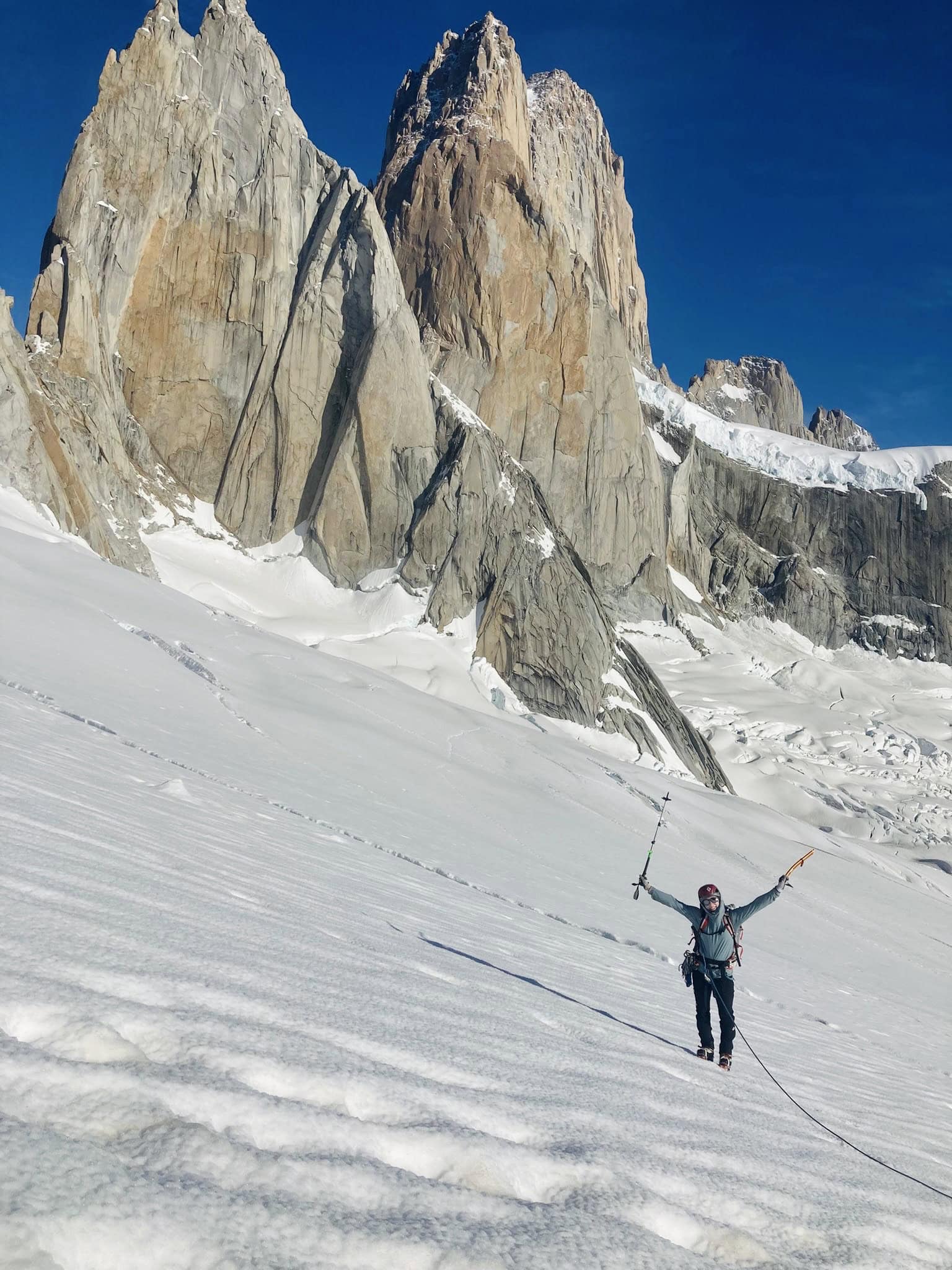
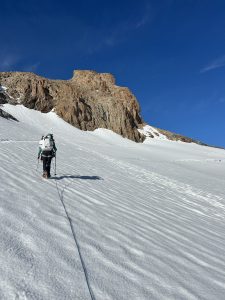
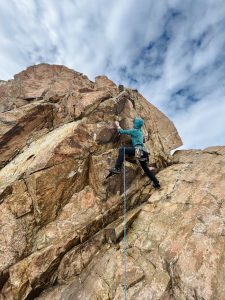
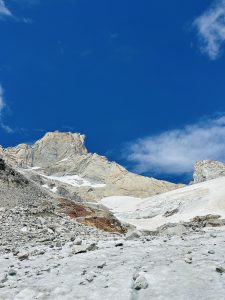
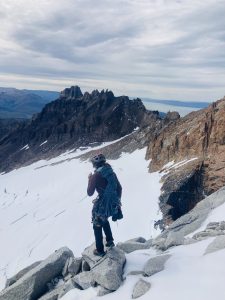
After a couple hours, we arrived at the Swiss Bivy and continued our journey upward. After some more walking up scree, talus, and slabs, we hit the snow, and eventually the glacier. We had arrived at the end of a long spell of good weather, so there were many tracks heading up towards Mojon Rojo, our day’s objective, as well as towards Aguja de l’S and Aguja Saint-Exupery. Straightforward glacier walking led us to a snow filled gully, the true start of our route. This presented, perhaps, the technical crux of our day. The snow in the gully was rotten and unconsolidated, making upward progress strenuous and slow-going. The snow was patchy so at times we climbed with our crampons over patches of steep loose scree, hooray! Eventually we reached the end of the snow in the gully, and switched to scrambling mode. Most of the Mojon Rojo East Face route involved third to fourth class ‘choose your own adventure’ type scrambling over ok rock. We made our way up, scrambling together, contoured right, and then up the final bit of elevation toward the summit nubbin. The final summit pinnacle involved maybe 15 ft. of climbing with steep 5.6 moves. Some people opt to call the plateau at its base the summit. Katie won rock paper scissors and led up the small rock spire. I also climbed up and rappelled down, happy I had a quick link with me to leave on the summit tat anchor. We took in the views of the magnificent Torre valley behind us before reversing our route. Overall Mojon Rojo was a perfect warm-up objective. It was fun and straightforward, reminiscent to me of the Shuksan Sulphide route. Plus, the views of the Fitz Roy massif were unparalleled.



We arrived back in town with sore legs and full hearts. The forecasted winds came in, and we were happy to spend a day resting, eating, and getting the lay of the land. Our rest was short lived, however. Another weather window had materialized on the meteogram. This time we set our sights on the Piedra Negra camp, which is accessed via the Rio Electrico valley. We had a couple objectives in mind for this area. One was the Amy-Vidailhet couloir, and the other was the Giordani ridge. In an ideal world we would have had time to attempt both, but this weather window was shaping up to be two and a half days. We would hike in 1/3, climb 1/4, and hike out 1/5 to avoid the precipitation and winds that were forecasted to arrive that afternoon. We settled on the Giordani as our objective. This turned out to be a good choice because some fellow climbers ended up rappelling the Amy-Vidailhet after climbing the Brenner-Moschioni and said the bergschrund was impassable and the couloir itself was in bad shape for climbing. Oh well! We’ll save that one for the next trip.

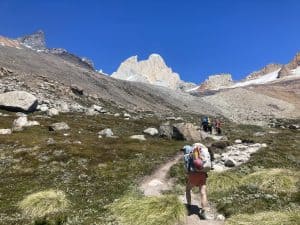
The hike into Piedra Negra was definitely my favorite approach we did. It starts with two hours of beautiful walking through lenga forest along the scenic Rio Electrico. The trail then takes an abrupt turn uphill, gaining 3,000 ft quite quickly to the Piedra Negra camp. We arrived in the early afternoon and had time to soak in the views. The camp perches above an electric blue lake, with views out onto the Patagonia Ice Field.


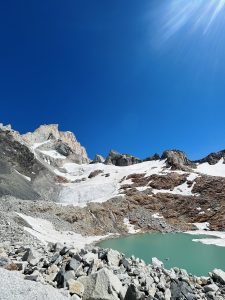
Another pre-dawn start and we were walking uphill towards the Giordani ridge. January 4th is my birthday, so I was hoping for an enjoyable day! Early on we opted to transition to crampons and walk up the dry glacier instead of sliding around on a mix of ice and rocks. We eventually veered right and skirted along the edge of the small remnant glacier, avoiding a visible serac zone and contouring up steeper snow slopes to a notch in the ridge which would mark the start of the Giordani ridge. There were a lot of climbers out that day, and most were headed to the popular Comesana-Fonrouge.
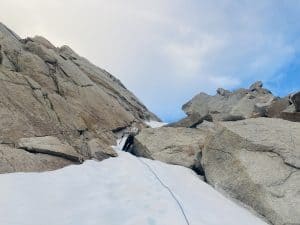
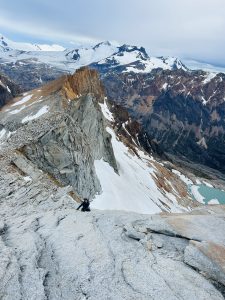
Once we had gained the ridge proper, we began to scramble up the beautiful, clean third and fourth class granite. At a point where the ridge steepened, we got out the rope and started simul-climbing. The Giordani presents beautiful views and fun movement with exposure. When we first gained the notch on the ridge, we had noticed the wind starting to pick up. We arrived at a sizeable ledge below a very interesting wavy rock feature, and the winds hit us in earnest. While the forecast hadn’t called for particularly high winds this day, the positionality of the ridge has us taking the brunt of the winds coming in from the north/northwest. The wind was like a physical presence, swirling around us and slapping against the rock with a loud crack. It sounded as if we had dropped something and it was slapping against the rock as it fell, but it was just the wind. I had never experienced this! I noticed this all with a sense of detached interest-the winds of Patagonia being renowned as they are. It did, however, make the movement of this exposed ridgeline we were traversing feel a bit more exciting! We decided to switch from simul-climbing to pitched climbing for the next bit, and Katie headed up the wavy rock gendarme as the winds gusted on.
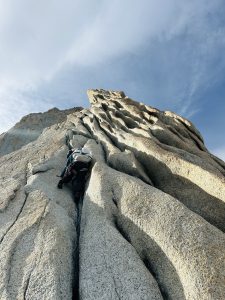
Katie reached a point on the underside of the steep leaning gendarme, and built a belay to bring me up. The way forward was likely a horizontal traverse beneath the steep point and beyond that, unknown. I took the rack and traversed across on positive edges above exciting exposure. As I rounded the corner, I came to a whaleback-like ridge feature which reminded me of the South Arete on South Early Winter Spire. I noticed a bail anchor which led down and right into a gully and pondered it, but then decided to stay on the ridge proper. I waited for a break between wind gusts and scampered across. I stopped to build a belay just as Katie let me know on the radio that I was almost out of rope. Huzzah!
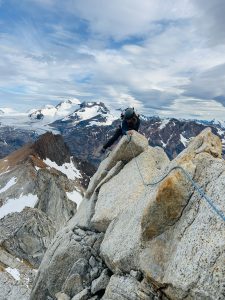
From there we simuled and scrambled some more until we arrived at our exit point. We were a bit confused about where to best exit the Giordani so as not to continue up the Comesana-Fonrouge. Ultimately we headed down a gully which we could see led to the steep snow slopes below. One rappel off some fixed tat brought us to a point where we could traverse on snow to the snowfield proper, and head down. We walked down a long talus field, which had us lamenting climate change and the glacier / snow that presumably used to cover this section. However, we arrived back safely at camp in time for a lovely afternoon of naps and lake time. Happy birthday to me!

We hiked out on 1/5 without incident other than some blustery winds while taking the tent down. That was followed with a rainy rest day in town, and then a moderately windy day during which we explored some of El Chalten’s sport climbing. We used the third day, also quite rainy, to prep for our final foray into the mountains. Grocery shopping and gear kit-honing. Our plan was to attempt the East Face route on Aguja de l’S. We had scoped this earlier from neighboring Mojon Rojo. We felt excited about the prospect of some more pure rock climbing. A concern / unknown we had was how the current weather system would impact the route. The East Face is known to be slippery on the lower pitches, holding ice and snow. When we had seen the route before after a prolonged dry spell it looked relatively dry, but we figured the current weather that had us inside in town would change that.
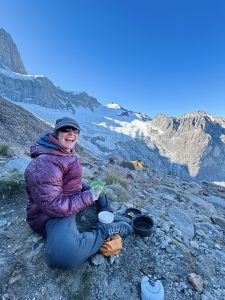

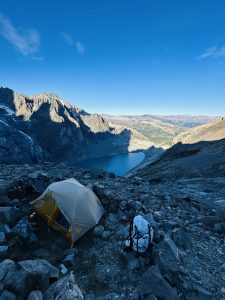
Luckily, some unknowns had been removed from the equation. We knew the approach, and gave ourselves an earlier start so that we could camp up at the Swiss Bivy, shortening our approach. We had also now seen the glacier, so we could dial in the gear we felt was appropriate for the short glacier crossing over to Aguja de l’S. The other component we were working with for this last venture, was the weather. A big weather system was set to come in 1/11 into 1/12. Winds gusts were forecasted to be above 100 mph. It was the talk of the town. People from our hostel host, to random passerbys on the trail, wanted to make sure we knew about it. We assured them that we did and had built in conservative margins for ourselves. We set off again up the Sendero al Fitz Roy on 1/9 under moderately overcast conditions. The walk up to the Swiss Bivy passed by uneventfully, and by early evening we were tucked into our tent.
We weren’t alone at the bivy that night, many parties also had the same idea as us for making use of this weather window. We decided on a moderately early start, and began walking up towards the glacier with headlamps. We had noticed a ‘sneak around’ out onto the glacier that allowed us to stay on the snow longer and avoid a rock island the standard approach crossed. This saved us a transition. Katie and I had joked multiple times over the trip about the tortoise and the hare parable, and how we were the tortoise – keeping a slow and consistent pace and ultimately reaching locations before those employing the ‘hare’ method. We watched this take place this morning as many parties made their way up onto the Rio Blanco glacier.

The new snow had covered all the previous boot packs. We had noted on our previous trip that a route taking a higher contour avoided the meat of the crevasse field. While many parties followed existing footsteps across the low, more crevassed route, we headed up and left to contour high. When we reached the base of the route there were two parties in front of us on the standard East Face route (which has alternative starts as well), with many parties coming up behind us. To get to the start of the route, you cross steep snow slopes with a runout into a pretty big crevasse. The platform that had been created at the start of the route fits two parties ‘comfortably’, and three uncomfortably. As we readied ourselves, Katie and I had a discussion about the amount of people. I was feeling concerned about the objective hazard created by so many people on an alpine route. Ultimately, we decided that due to our position in the queue, and the fact that we could descend from any point, we felt comfortable beginning up the route.


Katie took the sharp end to start out. The first pitch had some icy footholds and cracks, and both our fingers got pretty cold. Luckily, the sun began to hit as Katie was about halfway up the pitch. I arrived at the belay stance and headed up another pitch of crack with some snow in sections of it. The climbing was very fun and grippy granite crack climbing, and as our fingers and toes warmed we started to get into the flow and really enjoy ourselves. We were climbing beautiful splitter cracks in Patagonia, after all!
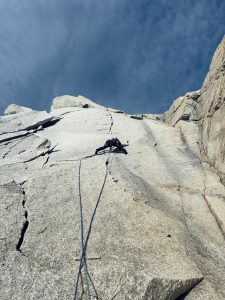

We continued moving upward efficiently until we had climbed five pitches. From there, the route rambles over some blocky 3rd and 4th class terrain mixed with snow, up to the final pitch of climbing to the summit. We began to scramble up and then paused for a discussion. In looking at the weather, we had set a turnaround time for ourselves of 11:00am. Normally I am not one for hard turnaround times, but rather assessing things along the way. However, due to the fact that a notably bad weather system was imminent, and the amount of people on the mountain that day, we wanted to give ourselves plenty of buffer to descend and get down out of the mountains safely with margin for factors such as stuck ropes and other people. Since it was almost 11, we made the decision to descend from that point. We had really enjoyed the climbing up to that point, and felt content with our efforts and the decision to prioritize a smooth descent. So, we began to rappel.

We started the rappels and ended up being somewhat in sync with a party from Switzerland. As we made our way down, switching off leading the rappels, we got to the rappel above the third pitch. Katie started heading down, and the rope remained weighted for some time. We were carrying rocky talkies, so I asked Katie what was up. She let me know that she was stopped mid rappel, because there were some folks at the next station who were lowering a person who had been hit by a rock. The stances were somewhat small, so she waited there mid pitch. Once the stance was clear, we joined her at the rappel anchor above the second pitch. Apparently, the man had been climbing the third pitch, when he was hit by a rock from a party climbing above. The injured party was from Brazil, and another separate party from Brazil with search and rescue experience was helping to lower him. We ended up all sharing ropes to rappel the final pitches to the ground.
When we reached the stance at the start of the route Katie, who is an EMT, offered to examine the injured man. He had lost a fair amount of blood, which had been visible on the route, but he was conscious and ambulatory. Katie had told the Brazilian parties that I worked as a guide and was comfortable in glaciated terrain. They requested our assistance in helping to safely escort the man across the glaciated terrain. The party who had helped lower the man luckily had a radio, and were already in communication with the national park. The plan was made to start downhill, while a separate search and rescue team from the park mobilized uphill.

While Katie assessed the injured gentleman, I got to work doing what Mt. Rainier taught me best – route work. The man could walk but was a bit unsteady, and the exit from the small belay ledge at the start of the route was a no-fall zone. I got to work improving and widening the track, which traversed the steep slope above some sizeable cracks. I also put in the two pickets Katie and I were carrying as running protection. The plan was made that I would lead, with the injured gentleman behind me, at a short interval from two of the Brazilian rescuers on either side who could assist or short rope him if need be, and at the back of the rope was Katie and she would remove the running pro. I let them know that I could switch to a belay at any time of the running protection didn’t seem prudent. Following us on the rope team behind were the party from Switzerland, and one of climbing partners from the team who had helped to lower. In this way, we set off slowly across the glacier.
We made it across the steepest section without incident, and continued at a steady pace down to the rocks at the edge of the glacier. Here we all paused to regroup. A guide from El Chalten was out walking on the glacier with some guests, and with his help, along with others involved, the man continued to walk slowly down toward the Swiss Bivy. Once there, we checked in with them and learned the park service was asking for vitals. While Katie helped obtain that information, I sorted our gear to re-pack and begin the hike out. Ultimately, the injured man walked, with assistance, down to Laguna Sucia where he was met with a quite sizable rescue team. We were a bit behind due to having to stop and repack our gear to descend, and we passed the rescue team transporting the man down a third class step below Laguna Sucia in a litter. We were later told that the rescue team had the man out at the trailhead that night, and he was then transported to a hospital. Overall we were impressed by the efficiency and skill of the El Chalten-based rescue team, and also by the way that climbers speaking multiple different languages all came together to work to help a fellow climber in need.
That night we stayed at Poincenot camp down in the trees. The wind really picked up in earnest and we could hear it roaring through the peaks above us, which made us glad in our decision to have descended. The next morning we woke early and made the final hike to town. We caught a bus to El Calafate that same afternoon, so we would be there in time for our flight to Buenos Aires the next morning. What a whirlwind!


This trip exceeded my expectations in many ways. It affirmed my own skillset that I’ve built in the mountains over many years. I was, as I said, pretty intimidated going in. What I found is that I have built a solid base of knowledge and experience to move in the mountains, to make decisions, to assess terrain, to listen to myself, to push myself, to plan logistics, to solve problems, and to work in a partnership. It was an incredibly empowering and inspiring trip. Just moving about in that landscape was inspiration in and of itself. Katie and I got to deepen our climbing partnership; supporting each other, pushing each other, learning from each other, and becoming better friends. I am already scheming how I can go back. The mountains are always such good teachers, and I feel grateful I was able to learn about myself through time spent in them. I am grateful to Alpine Ascents and the JRG grant for the support in this endeavor. I feel inspired to continue learning, growing, and progressing in my capacities as a mountaineer, both personally and professionally. Cheers!
The JRG Grant is awarded once a year in an effort to promote Alpine Ascents guides taking on new challenges around the globe. The fund is named in honor of Alpine Ascents friend, former attorney, and trekker Jim Roux, who lost his life in the September 11, 2001 terrorist attack. Jim fell in love Nepal after joining an Everest Base Camp trek with Alpine Ascents in 1999. Through this experience his eyes opened to a whole world unknown to him previously. In fact, he was on his way back to Nepal when his plane was hijacked. Upon his passing, Jim’s family reached out to Alpine Ascents, looking for a way to honor Jim and his love of exploration. From there the idea of the Sherpa Education Fund was realized and the JRG Grant was created to encourage Alpine Ascents guides to follow their dreams of exploration through travelling and climbing around the world.
This grant promotes climbing in unexplored areas on new or remote routes in the world’s great mountain ranges. It is intended for mountaineering endeavors within a guide’s ability that will add to their breadth of knowledge about technical mountaineering, international travel, and risk management. Lauren Hebert was the 2024 recipient of the JRG Grant.